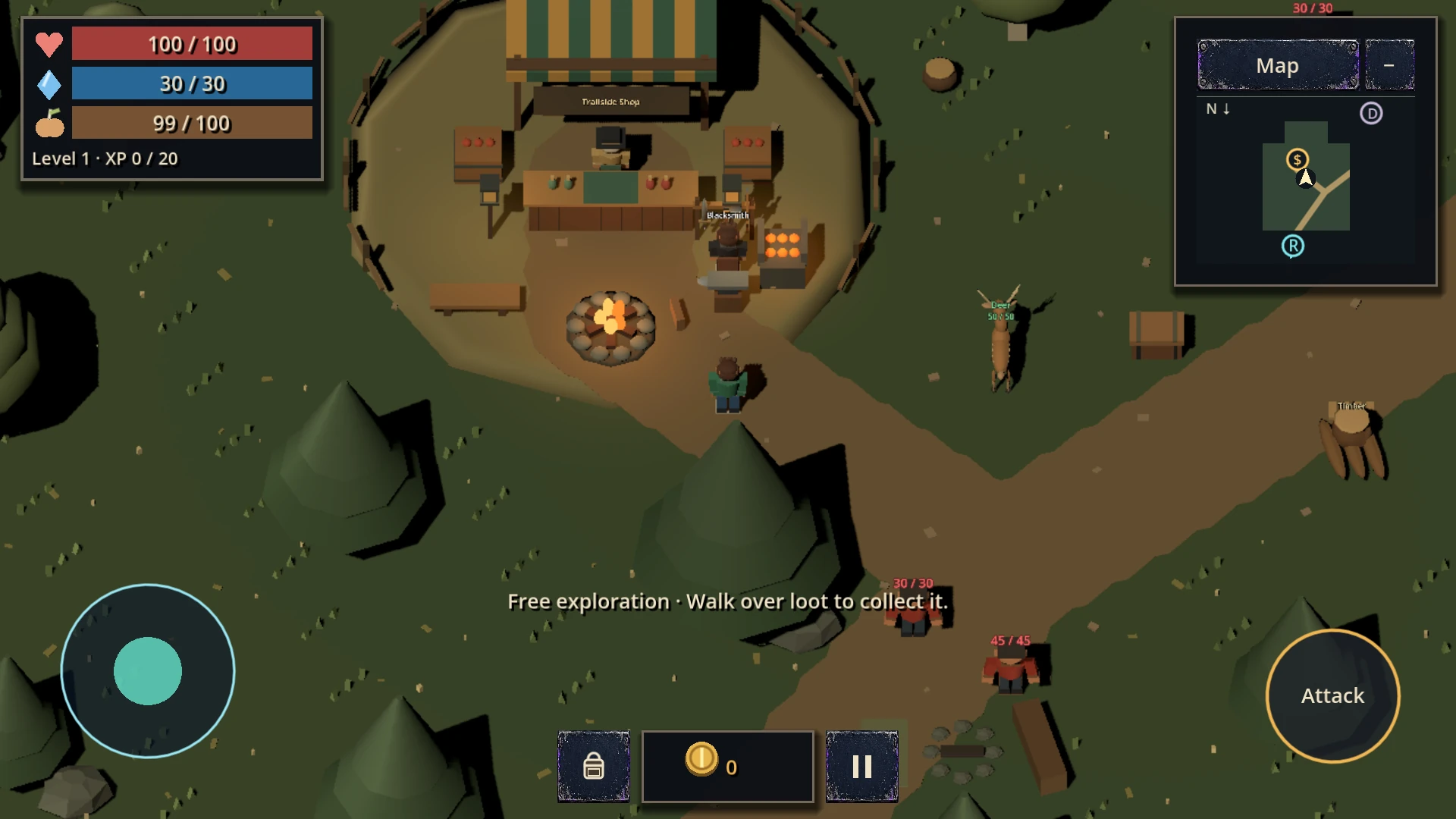
In the City Slash open world, a new weapon draws on the same stock of coins and materials as food, healing supplies, tools and jobs for the locals. Think about your next trip before you buy.
This guide covers the open-world economy and equipment. Campaign upgrades use crystals and follow different rules.
Pick your next task
Heading out to explore? Keep food your character can eat and something to heal with. For fishing, save up for a rod or set aside its ingredients. If you're going to repair the farm, hang on to wood and scrap metal.
Check how many of each item you're carrying as well as its price. Different vendors have different stock: a grocer and a blacksmith serve different needs. Selling something back usually brings in less than you paid for it.
At a regular trader, water costs 3 coins, an apple 4, a fish 5 and a medkit 18. Those prices help you plan a stop there. Other vendors carry their own selections.
Resources worth keeping
Wood, scrap metal and leather go into several blacksmith recipes. Selling your whole supply to fund a single purchase can delay the next tool you want to make.
Village jobs need materials too. The farm trough takes 4 wood and 2 scrap, and the mill drive needs 6 wood and 3 scrap. Set aside 10 wood and 5 scrap to cover both repairs.
Some jobs ask for ordinary food. Check the journal before selling an entire stack of fish, meat or vegetables. Ingredients for an active job needn't be marked as special quest cargo.
Grain, flour, straw and feed are materials. Carrying them doesn't mean your character can eat them. Read an item's description and check its available actions to see how it can be used.
Buy a tool or make one
At the blacksmith, a fishing rod costs 30 coins, a bow 60, a pickaxe 45, a sword 45, an axe 65 and a staff 35. Arrows cost 2 coins each.
You can also craft with your own materials while standing near the blacksmith. These recipes have no additional coin fee.
| Item | Materials | Output |
|---|---|---|
| Fishing rod | 4 wood, 2 leather, 1 scrap | 1 rod |
| Bow | 5 wood, 3 leather | 1 bow |
| Arrows | 2 wood, 1 scrap | 10 arrows |
| Pickaxe | 3 wood, 4 scrap, 1 leather | 1 pickaxe |
| Sword | 1 wood, 4 scrap, 1 leather | 1 sword |
| Axe | 3 wood, 5 scrap, 1 leather | 1 axe |
| Staff | 5 wood, 2 scrap, 1 leather | 1 staff |
| Vest | 4 leather, 1 scrap | 1 vest |
| Chainmail | 10 scrap, 3 leather | 1 coat of chainmail |
| Helmet | 4 scrap, 2 leather | 1 helmet |
Buy the finished item if you have coins to spare and another use for the materials. Crafting makes sense when you've already collected what the recipe needs. Compare it with your next job before deciding.
Workshops and production orders
In the crafts district you can supply a joiner and a potter. These jobs use materials to start a workshop order. You'll return to collect payment once the work is ready.
Talk to the craftsperson and accept the job. The joiner needs 6 wood and 2 scrap, the potter 4 wood and 2 water. Hand them over in the dialogue and check production progress. A batch takes 45 seconds of game time. If an earlier batch is already under way, the new order can take longer. Use the remaining time shown.
Return to the craftsperson when the order is ready and finish the job. The joiner's first reward is 75 coins, the potter's is 70. Residents then start delivering workshop products around the district. They handle deliveries, so there's no stool or pot for you to take out of your backpack and hand to a neighbour.
Repeat orders become available later. The joiner pays 20 coins for 2 wood and 1 scrap. The potter pays 18 for 2 wood and 1 water. Allow 15 minutes of game time between available repeat orders. Collect payment from the craftsperson.
Keep some wood, scrap and water even after you've equipped yourself. You can do other things in the world while the workshop is busy or waiting for another order. Production follows game time.
Selling safely
One equipped copy of a weapon or piece of armour is reserved. If you own just that copy, it can't be sold as spare stock. You can sell duplicates. Items protected from sale and special quest items are unavailable to sell.
Ordinary resources you've earmarked for a recipe can still be sold. Check your stacks before a big sale. A small supply of leather or scrap goes quickly when making equipment.
Wood sells for 1 coin, scrap for 2 and leather for 3. Raw fish sells for 3 and cooked fish for 6. Raw meat sells for 3 and cooked meat for 5. Cooking adds value but takes time at a campfire. Set aside your own food first and sell the surplus.
Before you set out
Check equipment, food and healing supplies. Read your current objectives and reserve the materials you need. Sell spare duplicates and leftover supplies. After buying or crafting equipment, open the backpack and equip it.
This order keeps the next trip in mind and saves you a journey back to replace a resource you just sold.